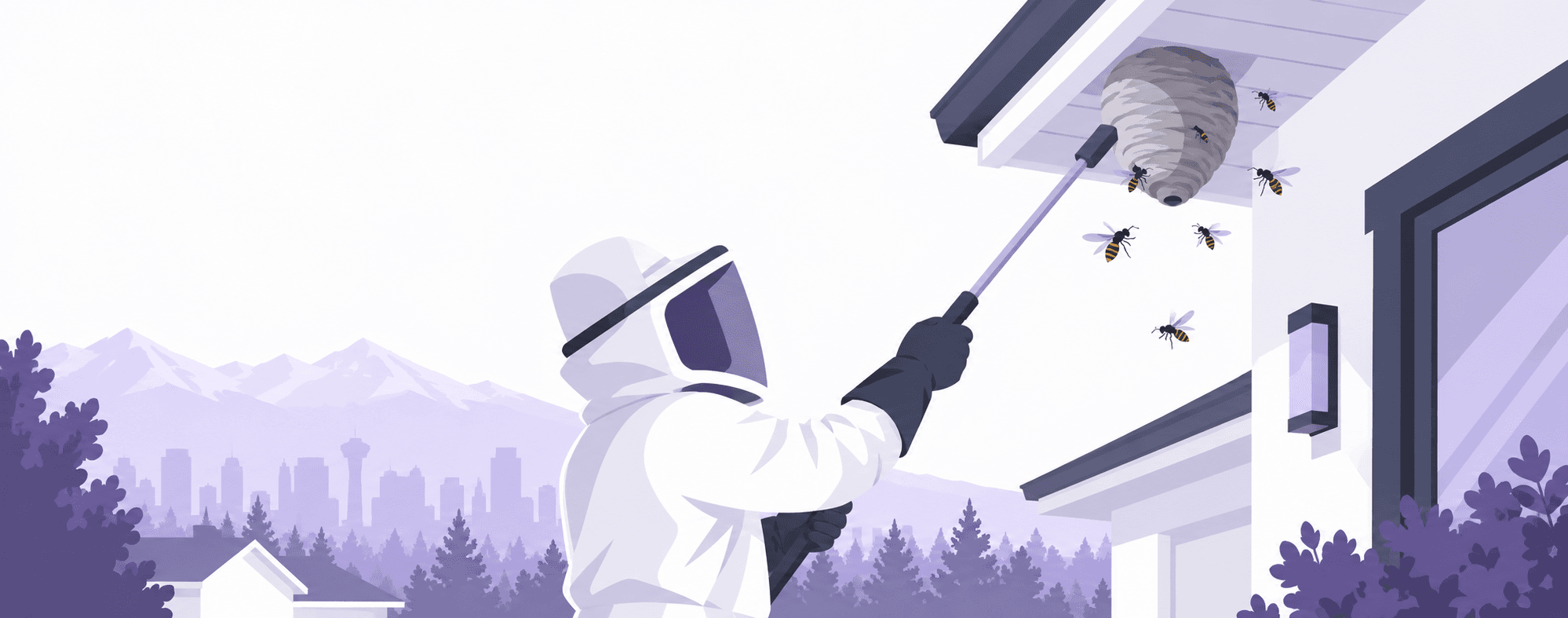
If you need same-day wasp nest removal in Calgary, contact YYC Pest Control as soon as you see a nest, repeated wasp traffic, or wasps entering a building. Tell the office where the activity is located, whether anyone has been stung, and whether the nest is near children, pets, customers, employees, or a main entrance. Same-day or 24-hour availability should be confirmed when you book, because response time can depend on technician availability, location, access, and the urgency of the situation.
Call for Same-Day Wasp Nest Removal in Calgary
A wasp nest can become more difficult to manage when it is near a doorway, deck, play area, restaurant entrance, rental unit, or building ventilation opening. Do not wait for activity to become severe before requesting an inspection. A technician can assess whether the nest is visible, concealed, or connected to wasps entering through a wall, roof, soffit, attic, or another access point.
For an overview of the service, see the wasp control service page. When you call, ask what response time is currently available for your Calgary address and whether the situation is suitable for same-day attendance.
When same-day or 24-hour response may be appropriate
Same-day help may be appropriate when wasps are actively entering a home or business, the nest is beside a frequently used entrance, or people and pets cannot safely use part of the property. It is also sensible to request urgent attention when wasps are appearing inside a building rather than only outdoors.
A fast assessment is especially important for:
- A nest beside a front door, patio, deck, walkway, playground, or business entrance
- Wasp activity inside a home, apartment, restaurant, rental unit, or commercial property
- Wasps entering through a wall, ceiling, soffit, roofline, attic, or vent
- A nest close to children, pets, customers, employees, or residents
- A known sting or a person on the property with a serious insect-sting allergy
- Activity that is interfering with a renovation, move-in, event, inspection, or business operation
Same-day service does not mean the technician can safely skip the inspection. The nest’s location, height, access, and connection to the building still need to be assessed before treatment begins.
What information to provide when booking
Clear information helps the office understand the urgency and prepare the technician. You do not need to identify the wasp species, but describe what you can see without approaching the nest.
Provide:
- The property address and community
- Whether the property is residential or commercial
- The number of nests you can see
- Where the nest appears to be located
- Whether wasps are entering a wall, roof, soffit, attic, or other opening
- Whether people or pets are being exposed to the activity
- Whether anyone has been stung
- Whether a ladder, locked gate, tenant notice, or property-manager approval will be needed
- A safe description of when the wasps are most active
Photos may help with an initial discussion if they can be taken from a safe distance. Do not move closer, open a wall, climb onto a roof, or disturb a nest to get a better image.
If you manage a building, tell the office which units, entrances, common areas, or business operations are affected. That information can help with access planning and communication before the appointment.
Calgary-area communities served by YYC Pest Control
YYC Pest Control serves Calgary and the surrounding communities of Airdrie, Cochrane, Okotoks, Chestermere, Carstairs, Strathmore, and Crossfield. You can also review the pest services area page when confirming whether your property is within the service area.
When requesting urgent attendance outside Calgary, give the full address rather than only the community name. Travel time, technician scheduling, and access conditions can affect the available appointment window.
Stay Safe Until the Technician Arrives
The safest temporary measure is distance. A wasp nest can look inactive while individual wasps are still present, and activity may increase if the nest or its entry route is disturbed.
Keep people away from the area and use another entrance or part of the property if possible. If the nest is affecting a business, property manager, or rental building, communicate the restricted area clearly to staff, tenants, contractors, and visitors.
How to keep people and pets away from the nest
Create as much space as the property allows without approaching the nest. Close doors and windows near the activity if doing so does not require walking close to the nest or opening a window beside the entry point.
Practical precautions include:
- Keep children and pets indoors or in a separate part of the property
- Stop using the deck, shed, play area, walkway, or entrance closest to the nest
- Place a temporary warning notice where staff, tenants, or visitors will see it
- Keep lawn equipment, toys, ladders, and other items away from the suspected nest area
- Avoid standing beneath a nest in a tree or beside a building opening
- Tell contractors and delivery personnel about the restricted area
- Keep food, drinks, and waste covered near outdoor seating or work areas
Do not assign someone to watch the nest from nearby. Monitoring can increase the chance of an encounter and rarely provides information that a technician needs for the inspection.
What not to spray, block, or disturb
Do not spray the nest with a household product, throw objects at it, hit it with a broom, or use water to knock it down. Do not seal an opening while wasps may still be inside a wall, roof, soffit, or other cavity. Blocking the visible entrance can redirect the insects into the building rather than remove the problem.
Avoid cutting into walls, removing siding, opening roof materials, or climbing to reach a high nest. These actions can create additional exposure and may make it harder to identify the nest and entry route.
Do not attempt to remove a nest simply because the visible activity appears quiet. Wasp activity can vary during the day, and a concealed nest may not be obvious from outside.
When a wasp sighting may require urgent attention
A single wasp outdoors is not always evidence of a nest on the property. Repeated traffic to one location, several wasps indoors, or wasps using a gap in the building are stronger reasons to request an inspection.
Ask for urgent guidance when:
- Wasps are inside living, dining, sleeping, or working areas
- The nest is beside an entrance or in a place people cannot avoid
- Wasps are concentrated around a wall, ceiling, roof edge, soffit, or vent
- Someone has been stung
- A person with a known serious allergy may be exposed
- Customers, employees, tenants, or children cannot safely use the affected area
If someone has severe symptoms after a sting, seek emergency medical help immediately. Pest-control attendance does not replace medical care.
How the Wasp Nest Inspection Works
The technician’s first task is to understand where wasps are active and how they are using the property. A visible nest may be only part of the problem when insects are entering through a building opening or nesting inside a concealed space.
The inspection should also consider people, pets, staff, tenants, customers, and anyone else who needs to use the property. Tell the technician about areas that must remain available, such as a business entrance, kitchen access route, rental-unit hallway, or shared outdoor space.
Where technicians look for hidden nests
Technicians may trace wasp activity around likely nesting and entry locations, including:
- Wall voids and gaps around siding
- Roof edges, soffits, fascia, and attic areas
- Eaves, vents, and other openings
- Trees, shrubs, sheds, decks, and outbuildings
- Gaps around doors, windows, utility penetrations, and exterior fixtures
- Areas where wasps repeatedly land, disappear, or emerge
The inspection is not limited to the point where you first noticed a wasp. For example, wasps around a window may be using a gap in the wall above or beside it. Activity near a roofline may connect to a concealed nest rather than a free-hanging nest that can be removed from the exterior.
How wasp activity and entry points are identified
The technician will look for repeated flight paths, visible openings, nest material, concentrated activity, and signs that wasps are moving into or out of a structure. The timing and location of the activity can help distinguish a nest in a tree or eave from insects entering a wall or roof cavity.
You can help by explaining when the activity began, whether it has increased, and where you first saw wasps. Mention any previous spray or treatment, especially if wasps continued to appear afterward.
The technician will also consider access. A nest behind a locked gate, above a commercial entrance, inside a tenant’s unit, or near a roof edge may require different preparation than a nest visible at ground level.
What changes when the nest is in a wall, roof, soffit, or tree
A visible nest may be easier to locate, but safe removal still depends on height, access, and the surrounding property. A nest inside a wall, roof, or soffit requires attention to the entry point and the enclosed space where the insects are active.
A tree nest may be exposed but difficult to reach safely. A nest near a roofline may require careful positioning to avoid exposing people below. In each case, the technician should explain the treatment approach and any areas that need to remain clear during the work.
What Happens During Removal and Treatment
After the inspection, the technician will explain what was found and what treatment or removal steps are recommended. The work may focus on a visible nest, the concealed nesting area, the entry route, or more than one location.
The exact sequence depends on the site. A treatment plan for a free-hanging nest is not automatically suitable for activity inside a wall or roof.
How professional-grade treatment is applied
Professional treatment is selected and applied according to the nest location, access, and level of activity. The technician may need to treat the nest directly, treat an entry point, or reach activity in a concealed space rather than simply remove a visible outer structure.
The technician should identify the work area before treatment begins and explain where people and pets must stay. Follow those instructions until the technician says the area can be used again.
Removal of the visible nest may be part of the work, but removing the outer structure alone may not address wasps inside a wall, soffit, roof, or other cavity. That is why the inspection and source identification matter.
Why visible wasps may remain active for a period after treatment
Wasps may still be seen for a period after treatment because some insects are away from the nest when the work takes place, and others may remain active before the treatment has taken effect. Seeing activity immediately afterward does not automatically mean the service failed.
Keep the area restricted for the period the technician recommends. Do not spray over the treatment, knock down the nest, or seal the opening without instructions. If activity continues beyond the timeframe discussed during the appointment, contact the company and report exactly where and when wasps are still appearing.
How family, customer, and employee safety is considered
Safety planning should account for more than the person who made the booking. The technician needs to know about children, pets, tenants, employees, customers, food-preparation areas, entrances, and shared spaces.
For a home, this may mean keeping family members and pets away from a deck, window, attic access, or side yard. For a business, it may involve coordinating around opening hours, customer flow, staff access, restaurant operations, or a rental property’s occupants.
If your property has special access or occupancy requirements, discuss them when booking. YYC Pest Control also provides residential pest control services and commercial pest control services, so the service plan can be discussed in the context of the property being treated.
What Affects Wasp Removal Cost
An exact price requires information about the property and the nest. Ask for an inspection or quote rather than relying on a price for a different type of nest or building.
Nest location, height, and accessibility
Location affects the time, equipment, and access planning required. A nest at ground level is different from one in a high tree, roof edge, soffit, attic, or enclosed wall.
The technician may need to account for:
- Height and safe approach
- Roof, ladder, or attic access
- Locked gates or tenant access
- The distance from people and active entrances
- Whether the nest is visible or concealed
- Whether work must be coordinated around a business or rental property
Give the office as much information as you can, but do not investigate the nest at close range for the purpose of getting a quote.
The difference between a visible nest and activity inside a building
A visible nest may be located and treated from outside. Wasps inside a building can indicate a concealed nest, an opening in the structure, or both.
When activity is inside a wall, roof, or soffit, the technician may need to identify how wasps are entering the occupied area and whether the source can be treated without creating a new route into the building. That additional assessment is one reason a visible nest and an indoor infestation should not be treated as the same job.
Why an inspection or quote is needed for an exact price
The company needs to see or understand the actual conditions before confirming the work and price. Tell the office whether you need same-day attendance, but expect the technician to verify the situation on site.
A written or explained service plan should identify the affected area, the recommended treatment, any preparation required, and what follow-up communication is appropriate. If the recommendation is not clear, ask what problem the treatment is intended to solve and what you should do if activity continues.
Prevent Wasps From Returning
Treatment addresses the current activity, but an opening may still allow future insects to enter. Prevention is most effective when the access point is identified and sealing can be completed safely after the nest situation has been addressed.
How access-point sealing supports removal
Sealing an opening can reduce the chance that wasps, or other pests, will continue using the same route. Timing matters when the nest is inside a wall, roof, soffit, or another enclosed location. Closing an opening too early can trap insects inside or push them into the occupied part of the building.
Ask the technician whether sealing is recommended, who should complete it, and when it is safe to do so. The answer may differ between a home, rental property, restaurant, office, shed, or apartment building.
Common Calgary home and business entry points
Potential access points include gaps around siding, soffits, fascia, roof edges, vents, windows, doors, utility lines, and exterior fixtures. Damaged screens, loose trim, and openings around service penetrations can also provide routes into a structure.
Do not assume every gap needs to be closed immediately. The technician should connect the proposed sealing work to the observed wasp activity and explain whether the opening is active, likely to be reused, or unrelated.
When follow-up treatment or prevention work makes sense
Follow-up may make sense when activity continues after the initial treatment window, when the nest was concealed, or when multiple entry points are present. It may also be useful for a business or rental property where access must be coordinated in stages.
Contact the company promptly if wasps reappear in the same location, move into another room, or continue using an opening discussed during the inspection. Describe the change rather than applying another product yourself.
Book a Calgary Wasp Inspection or Removal
A same-day request starts with a clear description of the hazard and the property. YYC Pest Control can then confirm whether a technician is available and explain what information is needed before attendance.
What to expect from the quote and service plan
Expect the technician to assess the nest location, activity, access, nearby occupants, and any concealed entry route. The recommendation should explain what will be treated or removed and whether any preparation or restricted access is required.
Ask these practical questions:
- Can a technician attend today or within 24 hours?
- Is the nest visible, concealed, or connected to indoor activity?
- Which areas must people and pets avoid?
- Will the visible nest be removed, treated, or both?
- Is access-point sealing recommended?
- What should be done if wasps remain active afterward?
- Is follow-up needed for a wall, roof, soffit, attic, or commercial property?
Residential and commercial scheduling considerations
Homeowners should mention children, pets, sleeping areas, decks, garages, and the entrances the household needs to use. Tenants should notify the landlord or property manager when access to a building area, wall, roof, or shared space may be required.
Commercial operators and property managers should identify customer entrances, staff areas, food-preparation spaces, tenant units, delivery routes, and operating hours. Early coordination can reduce disruption and help keep people away from the treatment area while the work is completed.
If the problem is part of a wider pest issue rather than a single wasp nest, describe the other activity during booking. The company’s broader listed services include residential and commercial work, inspections, ant, bed bug, cockroach, mice, rat and rodent, wasp, spider, mosquito, fly, beetle, boxelder bug, gopher, vole, sow bug, squirrel, skunk, bird, bird-and-solar-panel proofing, and exclusion or access-point sealing services.
The next steps for requesting service today
Call YYC Pest Control and provide the address, community, nest location, indoor or outdoor activity, exposure risk, and your preferred appointment timing. Ask whether same-day or 24-hour attendance is available for your property.
Until the technician arrives, keep people and pets away, avoid spraying or disturbing the nest, and do not block a suspected entry point. If someone develops severe symptoms after a sting, seek emergency medical help first.
The next step is simple: request an inspection now, describe the exact location, and wait for the technician’s instructions before approaching or treating the nest.